
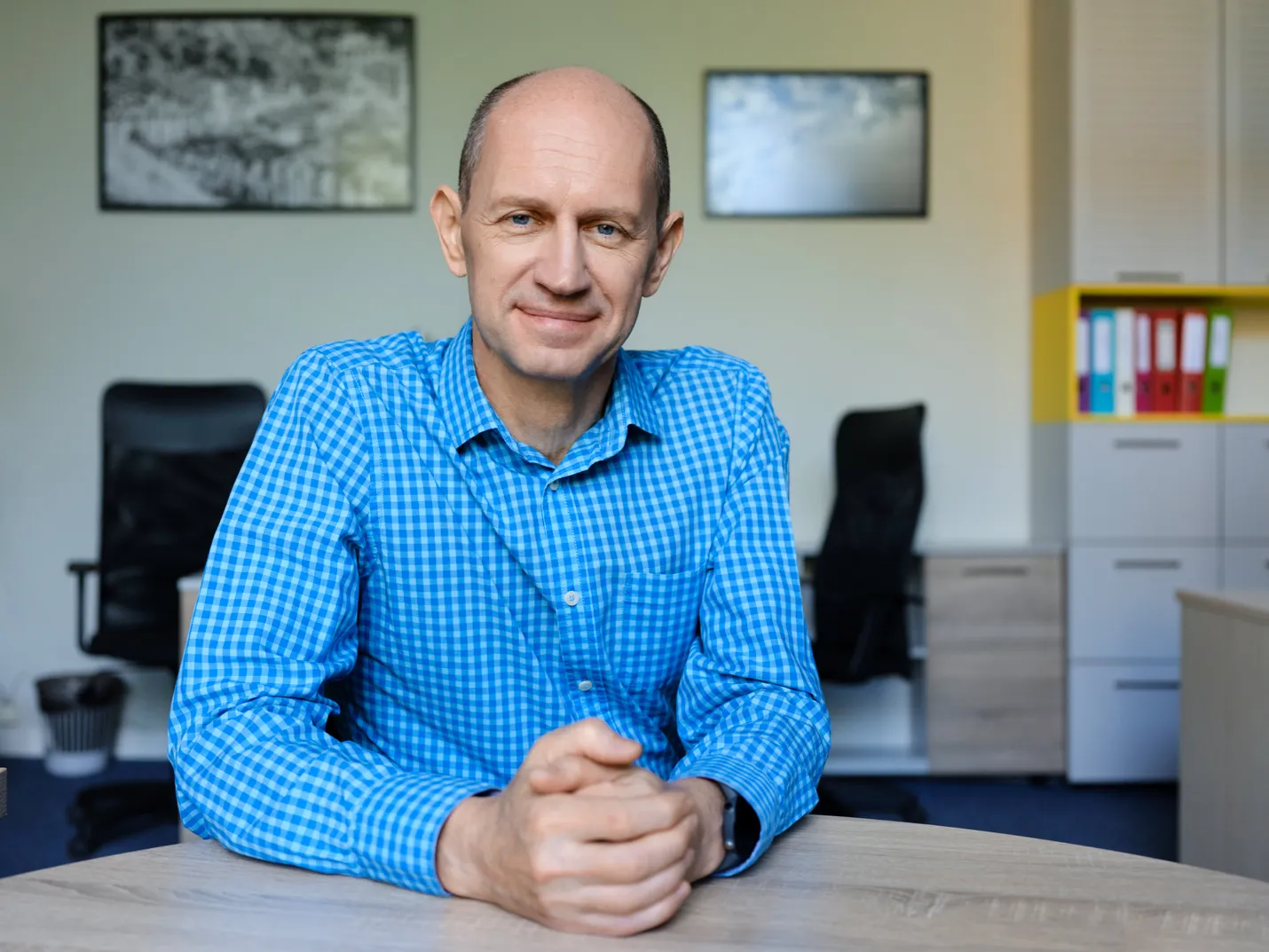
“90% of Ukrainian Businesses still depend on 1C”: the hidden threat facing companies and why AI won’t solve it Dmytro Popinako, Founder & CEO of Innoware, in an Interview with SPEKA
September 2026
While global businesses are investing billions in artificial intelligence, the reality for Ukrainian companies looks very different: more than 90% of businesses still use russian software products for accounting and business management, such as 1C and BAS.
Dmytro Popinako, Founder and CEO of Innoware, takes part in the Super Board 2026 special project and debunks the key myths surrounding the “omnipotence” of AI. He explains why Copilot will not replace people and why dependence on enemy software during wartime is a direct threat to national security.
Myths about AI and the reality of business digital transformation
When is it time for a business to start digitally transforming its business processes, and what mistakes should companies avoid at the outset?
Digital transformation is an abstract transition from one level to another, and everyone perceives it differently.
Today, as we have passed the quarter-century mark of the 21st century, managing business processes on paper is simply outdated. Technology naturally evolves through generations – from lamps and transistors to microchips.

Dmytro Popinako
CEO Innoware
The same can be applied to the concept of digital transformation of business processes. There are traditions, skills, habits, and principles. Essentially, these are business processes: people get used to working in a certain way. Then they realize that a new feature or a new approach can help organize the same process differently. This is the interpretation of digital transformation that can be applied to companies and business administration.
Software products evolve in much the same way. The systems we worked with 25 years ago, when Innoware was founded, are radically different from today’s solutions, although their basic purpose remains the same: their capabilities and toolsets have expanded significantly.
Is artificial intelligence already an effective business tool that delivers measurable results, or is it still mostly marketing hype?
In short – it has not delivered that yet.
If AI guaranteed a specific financial return, everyone would be talking about it. For now, it is a benchmark and a trend attracting massive amounts of capital based on expectations of future benefits. Vendors use AI as a marketing marker to promote their products, while the universal business impact is still far from obvious.
When it comes to personal productivity, large language models (LLMs) are genuinely effective: they can quickly find information and explain concepts. However, there is still no tool capable of replacing people across complex chains of business processes such as procurement, manufacturing, sales, and accounting.
Even the new AI agents that Microsoft is integrating into its ERP systems still require customization and proper configuration.
The advantage of paid enterprise Copilot is that it keeps data within the company’s environment, within its tenant, and helps prevent information leaks.
Today, many people try to make their work easier by uploading confidential information into open AI systems without thinking about where that information may end up. It can become available for training other systems. This represents a major security risk that legal departments need to address.
AI has proven effective as a personal assistant, but as a corporate tool, it has not yet reached the same level of maturity. Secure enterprise use cases are still ahead of us.
Legislation in many countries is already introducing restrictions designed to protect businesses from data leaks through open, free AI platforms.
Corporate solutions offer a safer alternative. In fact, 90% of companies on the Fortune 500 list already use Microsoft 365 Copilot.
Paid subscriptions provide additional privacy and security through tools such as Microsoft Purview, which can help prevent risky prompts and unintended disclosure of corporate information.
The key advantage of paid Copilot is that corporate data remains within the company’s environment. Using open AI systems for work-related documents, on the other hand, represents a significant security risk.
Why AI will not replace ERP systems or reople
Will AI agents replace traditional ERP systems by taking over the management of business operations?
No, they will not.
People will remain in their roles. However, due to the demographic crisis in Ukraine and around the world, the use of AI will become a necessity in the future – there simply will not be enough specialists.
Over time, these technologies will mature, and their application will become much broader.
Is Ukrainian business ready for a world where AI independently makes some business decisions?
Companies are looking for areas where these technologies can be applied, but there is still no established vision.
The main challenge for Ukrainian businesses today is not artificial intelligence, but the war and the economic environment.
We urgently need to bring Ukrainian legislation into line with EU standards. We cannot wait 40 years for an economic miracle, as South Korea once did. We need to move quickly.
Therefore, artificial intelligence is not a panacea.
Businesses need economic conditions that allow them to grow, especially considering that the costs faced by Ukrainian companies are currently among the highest in the world due to depopulation, the war, and the damage caused by russian aggression.
We need an extremely business-friendly environment so that companies can grow and contribute to the state budget.

The main challenges today are war, survival, and high operating costs. For businesses to grow, they need not so much AI as free economic conditions and rapid reforms..
What do companies expect today from implementing ERP systems such as Microsoft Dynamics 365?
An ERP system is simply a management tool that needs to be used effectively. It does not generate profit by itself. Its success depends on the competence and strategy of management.
The most important outcome of an ERP system is access to up-to-date, real-time information that enables managers to make appropriate decisions.
Therefore, ERP is not a way to make money. It is a tool for implementing management ideas and controlling their execution.
Which industries in Ukraine have the greatest potential for digitalization, and where is the situation the most challenging?
For Ukraine, it is critically important to eliminate russian software, which has deeply penetrated the business accounting and management software market.
1C and BAS are russian products that still have a dominant position. This needs to change because it represents a risk to the country and the economy.
Dmytro Popinako
CEO Innoware
Around 90% of Ukrainian businesses still use russian software.
Management teams are often poorly informed about the capabilities of modern Western systems and do not fully understand the benefits of moving away from 1C.
Business owners have invested in russian software for years and are reluctant to spend money on migration, especially while trying to survive the current crisis.
However, Ukrainian businesses do not fully recognize the security risks. Products such as 1C and BAS may contain backdoors that could potentially be used for espionage, given that their developers are directly connected to russia.
Companies do not necessarily have to replace russian software exclusively with foreign solutions. There are also high-quality Ukrainian products.
Foreign software has an advantage because more investment has gone into it and it offers broader functionality. However, Ukrainian products also have significant potential, and they deserve greater attention because they can become an important part of Ukraine’s export potential.
How has the full-scale war affected businesses’ willingness to invest in automation?
Budgets are largely frozen.
Automation is supposed to replace manual work with automated processes, but this is not happening to its full potential. Optimization is possible wherever data is still being transferred manually.
A properly implemented ERP system frees up human resources and increases efficiency.
However, every company is different, with its own unique business processes. Efficiency needs to be addressed systematically and continuously.
What is more difficult: implementing the technology or changing employees’ habits to adapt to it?
Technology cannot be implemented effectively without people.
But whenever systems can free up human resources, this should be done as quickly as possible, because human labor will always be more expensive than automation.
Will Ukraine remain solely a consumer of global IT, or can it build its own enterprise solutions in the coming years?
The next 10 – 15 years will be spent changing the monopoly of russian software.
It is difficult for Ukrainian developers to compete directly with giants such as Microsoft or Oracle.
We need to look for niches at the cutting edge of technology.
Large companies have an advantage, but their weakness is inertia and slow reactions to new trends. This is where Ukrainian companies should look for opportunities to establish themselves and grow.
To build a global product, we need investment and access to international markets, because domestic resources alone will not be sufficient.
If you were building Innoware today, in the era of rapid AI development, what would you do differently?
Nothing. Every decision is a product of its time. Twenty-five years ago, I chose Navision because it offered the ability to adapt the system to each client. The product was later acquired by Microsoft.
As for artificial intelligence, it is already integrated into the Microsoft ecosystem and does an excellent job of improving employees’ personal productivity. However, it still does not fundamentally impact complex business processes.
Original interview published by SPEKA

INNOWARE USA
501 Silverside Rd, Ste 105, # 4995,
Wilmington, Delaware, 19809-1376,
United States
Tel.: +1(302)4672024
E-mail: info@innoware.com
INNOWARE UAE
Premises 407-FZBA 055, 4th Floor, Sheikh Rashid Tower, Dubai World Trade Centre,
Dubai, United Arab Emirates
Tel.: +971588894591
E-mail: info@innoware.ae
INNOWARE UKRAINE
3, Sholudenka St., office 204 (Cubic BC)
Kyiv, Ukraine, 04116
Tel.: +380(44)4902220
E-mail: info@innoware.com