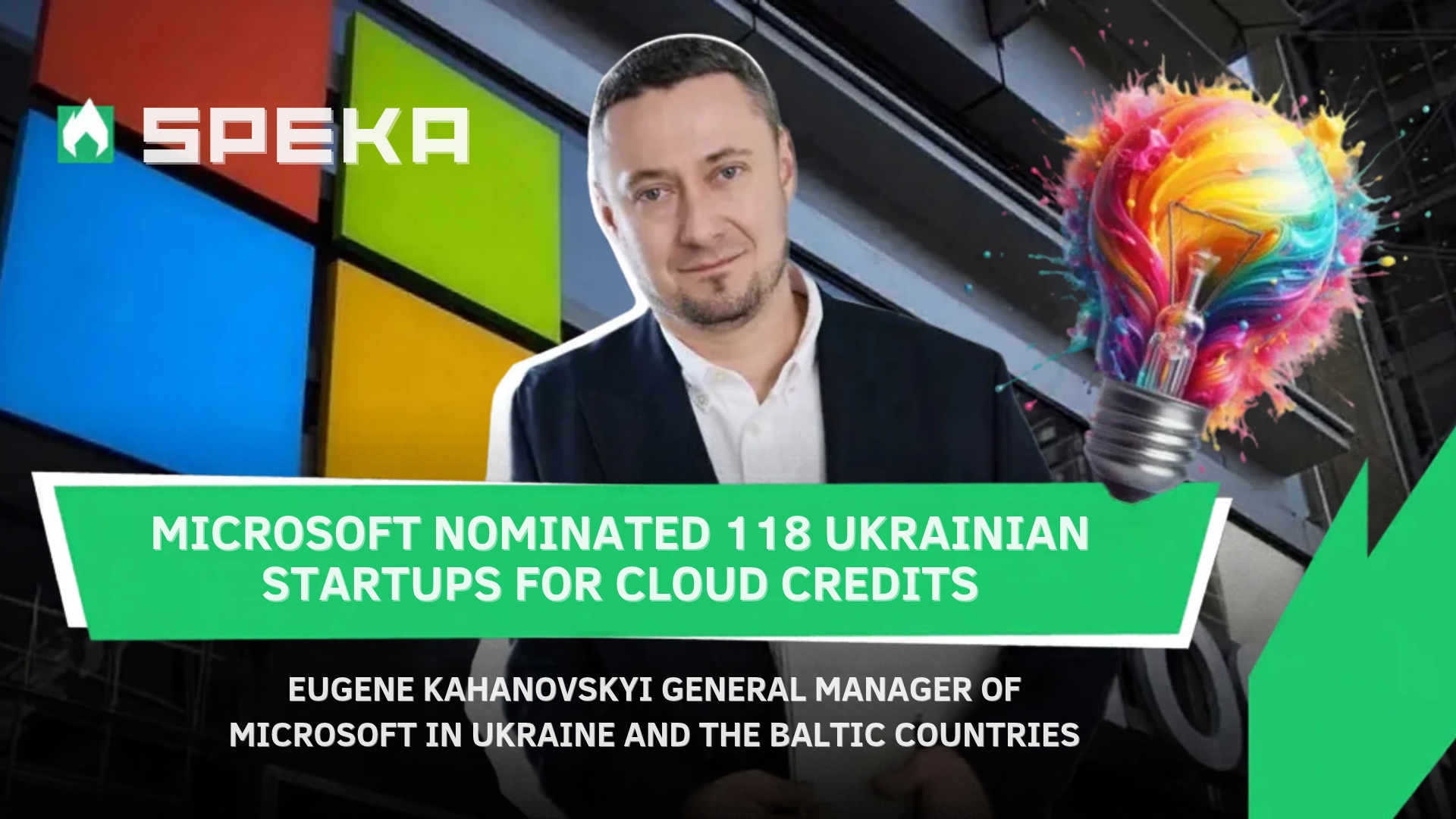
Eugene Kahanovskyi: “I’ve never seen a single case of successful AI implementation without changing business processes”
November 2026
Since the start of the full-scale invasion, Microsoft has become one of Ukraine’s key digital allies. In an exclusive interview with SPEKA, Eugene Kahanovskyi, General Manager for Microsoft in Ukraine and the Baltic Countries, discussed how the company helps protect Ukrainian government systems from cyberattacks, why companies can’t successfully implement AI without changing their business processes and how Ukrainian startups are using cloud technologies to conquer global markets.
Key takeaways from the interview:
- Microsoft is extending its support program for Ukraine through the end of 2027.
- Since 2022, the company has allocated more than $700 million in aid to Ukrainian government agencies, institutions and healthcare facilities.
- Generative AI is used by 9.5% of working-age Ukrainians, about half the global average.
- AI doesn’t deliver results without rethinking business processes. Adopting the tools is only the first step.
On Microsoft’s priorities, cybersecurity and the cloud
– Eugene, what are Microsoft’s top priorities in Ukraine today?
– What we’re doing now closely aligns with Ukraine’s needs because we’re focused on three core areas.
First, cybersecurity has become a much more urgent priority since 2022. Second, we’re focused on the cloud and helping Ukrainian companies stay resilient. Our third priority is artificial intelligence. AI used to be seen as something theoretical. Today, we’re talking about driving innovation by putting specific projects into practice.
– How deeply has Ukraine integrated AI into everyday life?
– According to the Microsoft Global AI Diffusion Report, 9.5% of working-age people in Ukraine currently use generative AI, compared with a global average of 18.8%. This shows how much potential we have to expand the use of these technologies and implement them effectively by working with the government and the private sector.
On artificial intelligence and business transformation
– How do businesses and company leaders view AI today? Have their needs around AI changed?
– Leaders are asking much more mature questions today. We used to talk about basic initiatives. Now businesses are asking specific questions: What part of the work can an AI agent handle (for example, as part of Copilot/Agent 365 solutions)? How secure is the agent? Which database can it access, and what are the limits of its permissions?
AI is used in virtually every area of business and is especially widely used in software development. But the technology only expands what’s possible. Leaders still have to decide where their teams should focus, where they need their own specialized expertise to develop internal or external services and where they can rely on technology. The final decision still rests with people.
YASNO, part of DTEK Group, is a good example. In the company’s contact center, an AI assistant powered by Azure OpenAI suggests responses to agents during calls. The average time to handle a customer inquiry fell from 4.5 to 3.5 minutes, a reduction of about 22%. What matters most to me in this case is where that extra time goes. YASNO reassigns its agents to handle more complex inquiries. Customers get answers faster and agents handle issues that AI can’t resolve on its own.
| Company | YASNO (DTEK Group) |
| Solution | AI assistant powered by Azure OpenAI for contact center operators |
| Request processing time | 4.5 min → 3.5 min |
| Effect | ≈ −22% less time spent per inquiry |
| How the time saved is used | Operators handle more complex inquiries |
– Can you simply give employees AI toolsand get great results?
– I haven’t seen a single successful case where people were simply given access to tools without changing the processes themselves. The right approach is to give people the tools and then, based on the results of their work, determine which processes need a complete redesign.
At Microsoft, for example, about 200,000 employees have access to these technologies. This makes the work of accountants, analysts, programmers, HR professionals and lawyers significantly more efficient. But implementing AI isn’t just a task for the IT department – it’s a transformation of the entire organizational model, processes and leadership. Every leader should ask themselves how they would have designed their organization’s processes if AI had been around at the time.

– Some forecasts suggest that AI will fully master human skills by 2037 and that this could pose risks. What does Microsoft think about this?
– It’s hard to make predictions that far ahead. I’d suggest looking at the historical context. About 200 years ago, businesses were built entirely on accumulating local expertise, which was worth its weight in gold. Today, technology is making expertise more accessible.
In the past, innovations emerged and it took years to adapt to them and invest in them. Today, innovations are emerging and being put into use at the same time. According to the IMF, AI could add between 0.1 and 0.8 percentage points to annual global economic growth over the medium term. This could be compared to a new Industrial Revolution. That’s why our focus should be on helping people and partners learn how to use AI effectively.
On supporting Ukraine since 2022 and the cyber front
– Microsoft has been operating in Ukraine for over 20 years. How has your role changed since the start of the full-scale invasion?
– We’ve been operating in Ukraine since 2003, continuously adapting our approach to supporting both the private and public sectors. Since the start of the full-scale invasion in 2022, the way we work with the Ukrainian government has changed dramatically. Microsoft has provided more than $700 million in assistance to Ukraine’s central government authorities, public institutions and healthcare facilities.
We provided free access to our online services, including the cloud platform Azure, which customers used to migrate their critical systems, as well as Microsoft 365. We launched this migration process within the first hours of the full-scale invasion, helping Ukraine maintain the operations of its banking system, telecommunications networks and government institutions.
| Microsoft in Ukraine | since 2003 |
| Supporting the public sector since 2022 | more than $700 million |
| Security alerts analyzed daily | more than 165 trillion |
| Microsoft security experts | around 35,000 |
| Ukraine support program | extended through the end of 2027 |
– What is the current situation with cyberattacks targeting Ukraine? How serious is the threat?
– Ukraine ranks first in Europe and third globally among countries where Microsoft customers are most frequently targeted by cyberattacks, according to the Microsoft Digital Defense Report 2026. Our global cybersecurity centers operate around the clock, analyzing more than 165 trillion security signals each day.
This work benefits both sides: we help protect Ukraine’s infrastructure while using insights into attack tactics observed in Ukraine to improve our security systems worldwide. Microsoft employs around 35,000 cybersecurity professionals globally.
– Is it possible to achieve complete protection against cyberattacks?
– The idea that you can eliminate the risk of attacks or stop them all is an illusion.However, an organization’s level of security depends on several critical factors:
- Implementing the Zero Trust approach.
- Regularly validating security measures and understanding your vulnerabilities.
- The speed at which services can be restored after an incident.
Cloud technologies help significantly by providing distributed data center infrastructure and built-in security controls that are enabled by default. Security is embedded and monitored at every stage of development rather than added at the end of a project. Since most breaches occur due to compromised passwords, modern cloud-based security models help organizations defend themselves against attacks more effectively.
✓ What is the Zero Trust approach
Zero Trust is a cybersecurity approach in which no user, device or service is trusted by default. Every access request is verified individually, and only the minimum permissions needed are granted.
– Organizations used to be concerned about the physical location of their data centers. How has this changed?
– That’s right. Just a few years ago, customers would frequently ask: “Where’s the data center located exactly, and where’s my data stored?”. Today, as organizations face both kinetic attacks and cyberattacks, they ask a different question: “How can I maintain control over my data and ensure business continuity if I lose access to my physical office or on-premises server?”. With an extensive network of data centers across Europe, Microsoft ensures data security and system reliability through cloud technologies.
On Ukrainian startups, education and plans for the future
– Are there any examples of successful Ukrainian projects built using Microsoft technologies during the war?
– Absolutely. A great example is the Ukrainian startup UADamage, which, together with our partner Kyivstar, developed a system for humanitarian demining and land damage assessment. By combining data from drones and satellites with AI-powered cloud technologies, the system enables much faster and more informed decision-making when it comes to demining operations. Today, the service is already being scaled up and exported from Ukraine to other countries.

– How does Microsoft support the Ukrainian startup ecosystem and education sector?
– We launched a support program together with the Ukrainian Startup Fund. Over the past 9 months, 118 startups have successfully completed the full validation process and have been nominated for grants in the form of Azure cloud credits, worth a total of $23.6 million.
As for education, our platforms are open to everyone. For example, over the past year, more than 130 digital leaders from the public sector have completed a personalized Microsoft training program through CDTO Campus, gaining the knowledge and skills needed to drive digital transformation directly within government ministries.
| Startups that completed validation | 118 |
| Azure cloud credits nominated for grants | $23.6 million |
| Public sector digital leaders trained through CDTO Campus | more than 130 |
– What are Microsoft’s plans for continued support for Ukraine?
– We’ve officially confirmed that Microsoft is extending its support program for Ukraine through the end of 2027. Our goal is to scale up this support. We’re working with hundreds of public and private sector organizations on cybersecurity and cloud migration.
In addition, I aim to serve as a bridge between Ukraine and the Baltic countries (Latvia, Lithuania, Estonia). These countries are actively sharing their experience in integration and adopting European practices and standards, which is extremely important for Ukraine on its path toward EU membership. At the same time, there’s also a great deal that the Baltic countries can learn from Ukraine. Our cooperation is certainly not coming to an end anytime soon. This partnership has a long way to go…

The original article is available at SPEKA.

INNOWARE USA
501 Silverside Rd, Ste 105, # 4995,
Wilmington, Delaware, 19809-1376,
United States
Tel.: +1(302)4672024
E-mail: info@innoware.com
INNOWARE UAE
Premises 407-FZBA 055, 4th Floor, Sheikh Rashid Tower, Dubai World Trade Centre,
Dubai, United Arab Emirates
Tel.: +971588894591
E-mail: info@innoware.ae
INNOWARE UKRAINE
3, Sholudenka St., office 204 (Cubic BC)
Kyiv, Ukraine, 04116
Tel.: +380(44)4902220
E-mail: info@innoware.com